the best
cottages
for less
 

Quick search

Start date (clear)
Calendar
Give or take
End date (clear)
Calendar
No. of nights
Region
Accommodation type
Max price/wk
Sleeps from
Accommodation code
More Search Options

Self catering cottages Wales

Mid Wales and Brecon Beacons

Visit Mid Wales for holidays and vacations set in the breathtaking scenery of Snowdonia, Brecon Beacons national park and Cardigan Bay’s stunning coastline. Find out how you can make the most of your self-catering cottage holiday in Mid Wales...


Machynlleth and Dyfi Valley, Mid Wales


Machynlleth - ancient capital of Wales
An historic base, home to Owain Glyndwr’s Parliament House, a prominent town clock and host to a Market every Wednesday. It has a reputation for its small, unique shops and also has a range of cafes, pubs and a supermarket. Machynlleth is also brilliantly located for touring the splendours of Snowdonia
to the north, the nearby Cader Idris range and the coastline to the west.

Beaches
Great sandy beaches run alongside both sides of the river Dyfi’s estuary, just 15 miles from Machynlleth, from Aberdyfi to Tywyn on the northern side and from Ynys-las to Borth in the south.

Things to see in Machynlleth and Dyfi Valley, Mid Wales
Centre for Alternative Technology has built an international reputation over the last 25 years, attracting people and students interested in aspects of sustainable living as well as those just looking for an interesting day out.

King Arthur’s Labyrinth offers underground caverns and a maze, with dramatic settings telling tales of King Arthur and other legends

Corris Craft Centre has a range of high quality craft units and Corris Tourist Information Centre.


Y Tabernacle (also known as Museum of Modern Art, Wales).


Activities in Machynlleth and Dyfi Valley, Mid Wales

Walking – ‘Glyndŵr’s Way’ National Trail offers some of Mid-Wales` finest scenery, ranging from rolling hills, woodland and country lanes to open hill and mountain.


Also, Cadair Idris and Aran Fawddwy, both claiming the second highest mountain in Wales tag, offer a good challenge to the more ambitious amongst you!


Cycling - Dyfi Valley offers the perfect cycling destination for people of all ages and abilities, including the three cross country routes (Mach 1, 2 and 3) and the Cli-Mach X trail in the Dyfi Forest north of the town. Bring your own bike or hire one from The Holey Trail in Machynlleth.

Horse Riding - National Bridleway Route, Prince Llywelyn Way and numerous other bridleways.

Water Sports - Sailing, sail boarding, rowing, canoeing, fishing and boat trips based in Aberdyfi. Sailing also at Clywedog Reservoir.

Golf at Machynlleth, Borth and Aberdyfi.

Fishing (sea and river) including salmon and sea trout fishing on the renowned River Dyfi. Clywedog Reservoir is also popular for fishing.

Clay-shooting Dyfi Valley Activity Centre is one of the most extensive clay pigeon shooting grounds in Britain and provides equipment and tuition.

Aberdyfi Outward Bound - a wide range of activities including sailing, canoeing, improvised rafting, rock climbing, gorge walking, mountain expeditions and orienteering.

Bird-watching, especially on the estuary, with Red Kites on the moors and mountains.

Local History & Culture
Recently voted 23rd in the BBC’s unprecedented public search for the greatest Briton of all time, Owain Glyndwr is a highly iconic figure in Welsh history. Described in Shakespeare's Henry IV, Part I as "not in the roll of common men", he assembled a national parliament at Machynlleth in 1404, drawing up mutual recognition treaties with France and Spain. At Machynlleth, he was also crowned king of a free Wales. The parliament still stands proud in the middle of town.

Today, the Welsh language and culture remains central to life in the Dyfi Valley and offers that ‘something extra’ to your visit. With over two thirds of the population totally bilingual (Welsh and English), it’s very possible that you will also pick up some of the language during your stay.

Events
A summary of up and coming events, places of interest etc in the area can be found on www.dyfidiary.co.uk.

View Self Catering Holiday Cottages near Machynlleth, Mid Wales.


Welshpool and surrounding area, Mid Wales

Welshpool - Where Wales Begins

Welshpool, or in Welsh, Y Trallwng, is a market town situated 4 miles (6 km) from the Wales-England border. The Canal at Welshpool take’s you back to a bygone era and the busy market town of Welshpool is a great place to do that all important shopping.


Things to see in Welshpool and surrounding area, Mid Wales

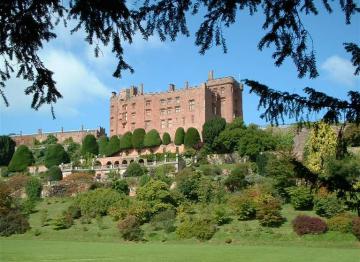
Powis Castle Gardens – the castle and its world famous Garden is one of the National Trust’s most visited properties.

Llanrhaeadr Waterfall – known as Pistyll Rhaeadr is the UK’s tallest single drop waterfall at 240ft (80m) high.

Lake Vyrnwy - created by a dam built in 1888, is in the beautiful, wild and mostly unpopulated countryside of Montgomeryshire. The land is a nature reserve and a bird watcher's paradise. There is a drive around the entire lake and over the dam. The noise of the water pouring over the dam is both thundering and mesmerizing.

Bell Museum, Montgomery - The county town of Montgomery is an unspoilt architectural gem and a delight to explore with its short cobbled street hugging the hillside. The tiny Bell Museum is full of interesting treasures.


Montgomery Castle - above the town, is one of a number built along the line of the English/Welsh border which for many hundreds of years was an area of political conflict and tension.

Dolforwyn Castle - on a hill rising above Abermule (11 miles south of Welshpool), was the final castle built by Llewelyn, the last independent Prince of Wales. It is very different to English castles built at the same time, making it one of Wales’ great historical treasures.

Hen Domen Castle - Built during Henry III's campaign against Llywelyn ap Iorwerth, the Castle succeeded the Motte & Bailey at Hen Domen, one mile to the North West, after 1223. Hen Domen, once a timber castle, is now one of the most extensively excavated timber castles in Britain. It was built in the 1070's (not long after the Norman Conquest) by Roger, Earl of Shrewsbury.


Activities in Welshpool and surrounding area, Mid Wales

Welshpool & Llanfair Steam Railway – weaves its way through the delightful Banwy Valley.

Montgomery Canalderelict for many years, is now being reborn as a cruise way through the picturesque Welsh Marches.

Walking - Offa’s Dyke long distance footpath continually crosses between England and Wales. The historically significant Glyndwr's Way completes its 132 mile trek in Welshpool. The Ann Griffiths Walk, used together with Glyndwr's Way, makes for an excellent looped walk weaving though the stunning Vyrnwy Valley. Other footpaths include Severn Way and Canal Towpath.

Pony trekking - Mid Wales Off Road

Quad trekking – Commando Paintball & Border Quad Trekking

Water Sports - Sailing at Lake Vyrnwy and Bala Lake

Golf courses – Welshpool Golf Course, Llanmynech Golf Course and

Fishing - Montgomery Canal, Moel-y-Garth Carp Pools at Guilsfield, Coed-y-Dinas in Welshpool, Llyndu Pool in the Lower Park of Powis Castle, River Severn at Lower Leighton, River Vyrnwy near Llanymynech, River Banwy in Llanfair and the River Camlad near Forden.

View Self Catering Holiday Cottages near Welshpool, Mid Wales.


More About Mid Wales


This area of Wales is divided into three regions: Brecon Beacons, the Heart of Wales and the old county of Montgomeryshire.


Brecon Beacons National Park

The Uplands of South and Central Wales, a high country consisting of gently rolling moors, forests, plateaus, farmland, rivers and streams is known as Brecon Beacons. The National Park, lying within the southern uplands, is 519 square miles (1344 sq. km) in size and stretches 40 miles (65km) from east to west. There are four mountain ranges within the park. Near the border with England are the Black Mountains, Next lie the Brecon Beacons, then the Fforest Fawr and, in the far west, the wilderness of Black Mountain. The two highest peaks in southern Britain are located in the Park.

Because of the different patterns of limestone and grit erosion which dominate the area, waterfalls, gorges and caves have formed over the centuries.


Brecon Beacons National Park

Peregrine falcon and raven can be seen in flight. Look for red kites in oak and ash woodlands. Arctic alpine plants blossom, while in the valleys, foxgloves and bluebells hold sway.

The Usk is the major river in the park. It is famous for both salmon and trout fishing. The Wye flows along the eastern Park boundary and the Tywi in the west. Other rivers disappear into caves. At Devil's Bridge, the Mynach River plunges 300 ft (91.4m) on its way to meet the River Rheidol. Man-made reservoirs have added to the natural lakes in the area.

Remnants of chambered long cairns dotting the valleys attest to man's long habitation in the area. Mysterious standing stones hide in the mountains. Iron Age man and the Romans built fortifications in the area, and the Normans, when they conquered Britain, constructed castles. Sheep and cattle are scattered throughout the landscape.

A good place to start a journey is at the Brecon Beacons Mountain Centre, six miles (10km) southwest of Brecon. There are waterfalls, old viaducts, reservoirs, castles, caves and walks to be enjoyed amid nature's scenic wonders.


Towpath walk along the Brecon Canal

Rolling hills, mountains, valleys, meadows and the Wye River characterize the Heart of Wales. The perfectly preserved Victorian and Edwardian spa town of Llandrindod Wells boasts tall houses with towers, turrets, balconies and ironwork.


Exterior of the Judge's Lodgings, Presteigne

The atmospheric Judge's Lodgings in Presteigne is lit by gaslight as it was during Victorian times. Original furnishings grace the elegant apartments. The fully equipped servants' quarters and huge courtroom are part of this 1870 Shire Hall.

Knighton, a small market town, sits on the Welsh-English border at the approximate mid-point of Offa's Dyke Path. It is the home of the Offa's Dyke Centre with an interesting exhibition and AV presentation. The town, with many 17th century houses, is on the hillside above the Centre. Traces of late stone & Bronze Age settlements and Iron Age fortifications can be found in the surrounding area. It was the scene, 700 years ago, of one of Owain Glyndwr's victories against the English.


View Self Catering Holiday Cottages in Mid Wales


Bookmark and Share
Secure credit card processing